Sheet 05 · Comparison
Electric heat cable vs. glycol
Both methods keep the base under a freezer above freezing. They differ in what sits in the floor, what sits in the mechanical room, and how a failure is found and fixed.
01Components side by side
| Item | Electric heat cable | Hydronic (glycol) |
|---|---|---|
| In the floor | Self-regulating cable in ¾″ or 1″ rigid conduit loops | Glycol solution in HDPE or PEX tubing loops |
| Heat source | The cable itself | Electric or fuel-fired heater, or heat reclaimed from the refrigeration system |
| Distribution | Circuits switched by solid-state relays | Circulator pump, supply and return manifolds, balancing valves |
| Other equipment | Control panel only | Expansion tank, air separator, fill and purge station, relief valve, flow switch |
| Monitoring | Ground temperature per zone, far-end voltage per circuit, continuity per run, ground-fault status | Ground temperature; supply/return temperature, pump status and flow can be added |
| Maintenance | Periodic check of alarms, current and insulation resistance | Glycol concentration and inhibitor testing, pump service, air removal, valve checks |
| Repair in the floor | Pull the cable from the conduit and pull in a new one | Locate the leak, then cut the slab to repair tubing |
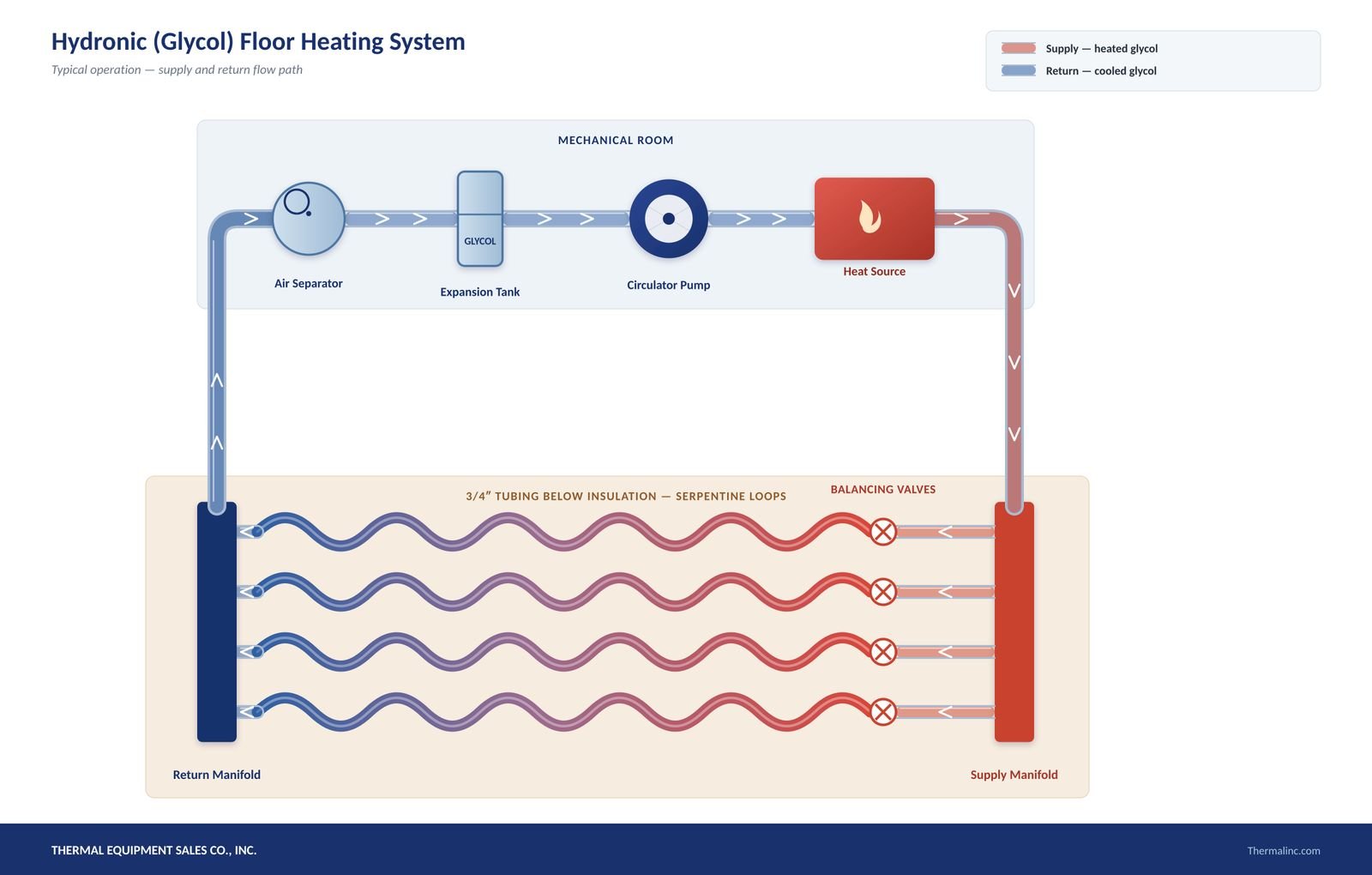
02Failure points and how they show up
Glycol
| Failure | Effect |
|---|---|
| Leak in buried tubing or a fitting | Slow loss of pressure and flow; glycol released to the soil; hard to locate under the slab |
| Pump failure | All loops lose flow at once unless a standby pump is installed |
| Air in the system | Reduced flow in some loops; noise and cavitation |
| Balancing valves drift | Some loops under-supplied; cold spots at the loop ends |
| Glycol degradation | Lower freeze protection and more corrosion unless tested and maintained |
| Heater fault or loss of flow at heater | No heat to the field; element damage risk |
Electric
| Failure | Effect |
|---|---|
| Cable damaged or open | Only that run is affected; end-of-run and far-end voltage alarms identify it |
| Solid-state relay fails open | No heat on that circuit; far-end voltage alarm on call for heat |
| Solid-state relay fails shorted | Circuit heats continuously; far-end voltage present with no call for heat is alarmed |
| Ground fault or moisture at a termination | That circuit's ground-fault breaker trips and is alarmed; other circuits keep running |
| Sensor lead broken | Sensor fault alarm |
Both systems stop heating during a power outage. The ground's thermal mass carries the floor through outages of hours or days; what matters is that faults are found and fixed while the system is powered.
03Choosing between them
Electric fits well when
- The facility wants circuit-level fault detection and a simple mechanical room
- No reliable source of waste heat is available
- Maintenance staff are electrical rather than hydronic
- Fluid in the ground is a concern (food plants, pharmaceutical, environmental sites)
Glycol fits well when
- Refrigeration heat reclaim can supply most of the heat on a very large floor
- The owner already maintains hydronic systems and glycol
- Redundant pumps and heaters are designed in
Operating cost for electric is the design load times the hours the controller calls for heat. For glycol it depends on the heat source, pump power and piping losses between the mechanical room and the floor. Compare them for the actual floor and utility rates.